There are a few vehicles in the world that don’t need an introduction in desert circles. The Ford F-150 Raptor is one of them. It’s not famous because it looks aggressive or because it’s expensive. It’s famous because it’s built with desert driving in mind — the kind of driving where speed, heat, repeated impacts, and split-second decisions punish weak platforms. In our world, the Raptor is more than a truck. It’s a desert benchmark.
01 Two Ways to Do It Right
Today, two versions matter most for extreme desert use: the F-150 Raptor (3.5L High-Output V6) and the F-150 Raptor R (5.2L Supercharged V8). They deliver different flavours of performance, but they share the same core advantage: they are both highly upgradeable desert platforms with one of the strongest aftermarket ecosystems on the planet.
02 Raptor 3.5L — The Desert All-Rounder
Who It’s For
The 3.5L Raptor is for the driver who wants a truck that’s already desert-capable out of the box but still has unlimited upgrade potential. It’s the one you choose when you want high-speed stability without needing to “build the truck first,” a platform that can do weekend dunes, long desert runs, and daily driving, and a proven setup that doesn’t rely on extreme modifications to be fun.
For many drivers, this is the best balance of capability, practicality, and value.
Why It’s Earned Its Reputation
The Middle East desert has a specific personality. It’s not just sand. It’s heat, chop, sharp dune transitions, long repeated impacts, and terrain that can go from smooth to violent within minutes. The 3.5 Raptor earns its place because:
- It’s stable at speed. Built to stay composed when the desert gets rough.
- It’s predictable. That matters when you have to choose a line in half a second and commit.
- It can be driven hard for long sessions. Many vehicles feel good for 10 minutes. The Raptor is designed for the long game.
- It upgrades properly. The platform doesn’t fight you when you start improving it.
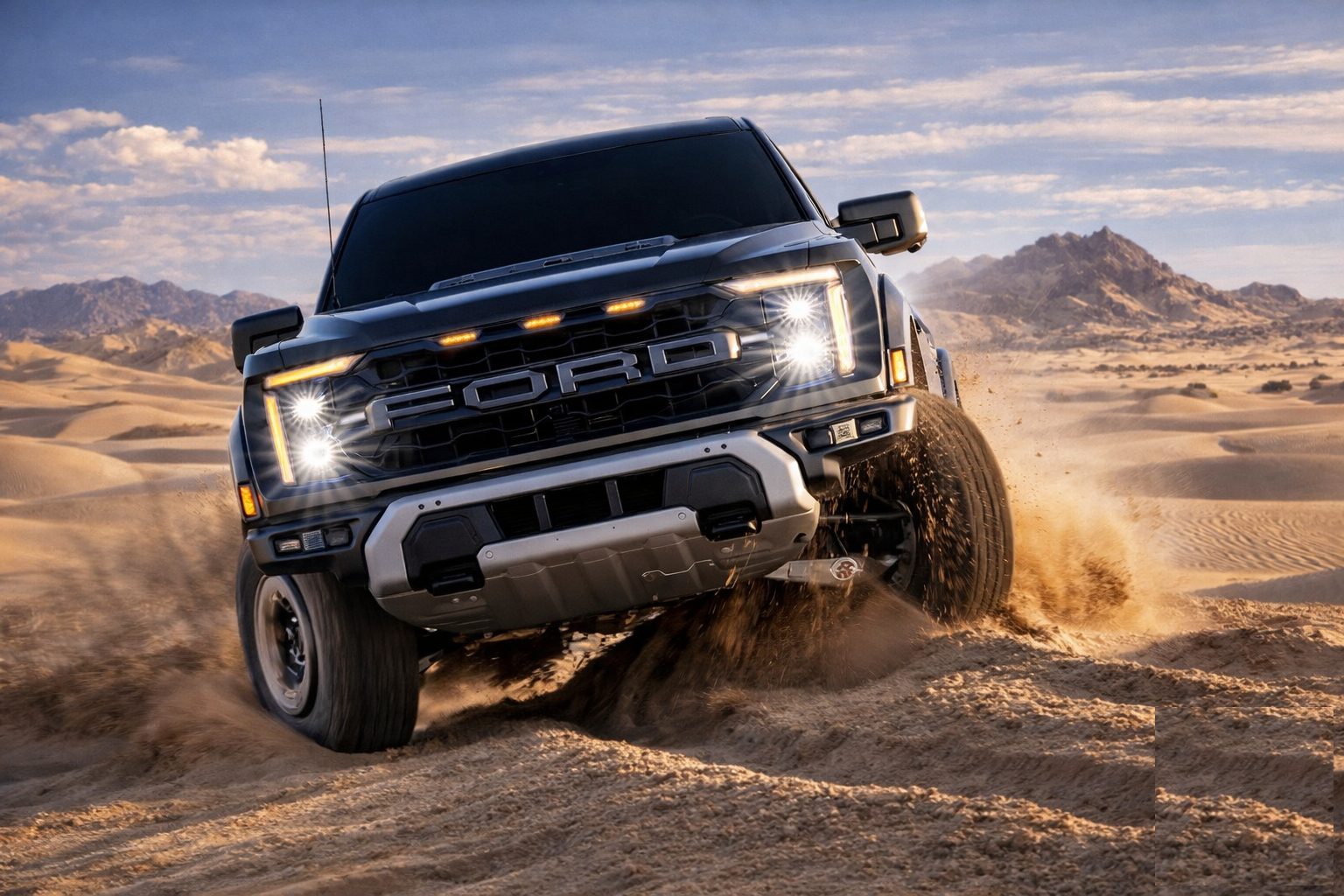
03 Raptor R 5.2L — Factory V8 Dominance
Who It’s For
The Raptor R is for the driver who wants the ultimate Raptor experience — the one that feels like Ford decided to create a desert truck with zero regard for restraint. This is for people who want maximum punch in sand, drivers who want the “V8 feel” and instant aggression, and enthusiasts who want the most iconic factory desert truck Ford can build.
What It Brings
The Raptor R is powered by Ford’s 5.2L Supercharged V8, often referred to as the “Predator” engine. Depending on model year and market, the Raptor R is quoted as 700 hp at launch, later commonly listed as 720 hp, with 640 lb-ft of torque (about 867 Nm). That’s serious power. But the bigger point isn’t the number — it’s how it feels. Supercharged V8 torque delivers a punch that makes dunes feel smaller than they are.
Ford also highlights its off-road intent with factory FOX shocks and available 37-inch tyres — which tells you exactly what the Raptor R was designed to do.
04 Why the GCC Heat Test Matters Here
The Middle East heat doesn’t care about hype. It cares about systems — cooling, durability, control, and how a vehicle behaves under stress. Both Raptors make sense for GCC use because:
- Power is always available. No waiting, no needing more run-up.
- Built for aggressive terrain. Doesn’t feel like a normal truck pretending to be off-road.
- Confidence on demand. In soft sand, torque is a tool.
- Factory desert package. The truck arrives more than half-built for what it does.
Both Raptors score 21/30 — six points below the top-tied five at 27/30. The honest analytical view: Reliability (3/5), Maintenance Ease (2/5), and Heat Resilience (3/5) all lose points against the Japanese top-tier. These trucks are built for desert performance, not Toyota-bulletproof longevity. Aftermarket Support (4/5) and Desert Suitability (4/5) are strong but not the regional class-leaders. Mod Potential (5/5) is where they tie at the top — the widebody/long-travel ecosystem is genuinely deep. Translation: these trucks dominate the “factory desert performance” question. They don’t compete on long-haul reliability or low-maintenance ownership.
05 The Trade-Offs
3.5 Raptor — Manageable Compromises
It’s a full-size truck, so agility isn’t like a short-wheelbase 4×4. You must learn desert positioning and line choice. Any high-performance vehicle needs proper maintenance discipline, especially if it’s driven hard. Some owners get tempted to chase power before control — that’s always the wrong order in the desert.
Raptor R — Wilder Trade-Offs
This truck is wild. That comes with consequences. It will drink fuel if you drive it like it was built to be driven. It’s still a big truck — power doesn’t remove the laws of physics. And it needs driver maturity — the Raptor R can get you into trouble faster than slower vehicles can.
06 The Moterr Rule Applies to Both — Suspension Matters Most
We don’t care if you’ve got 450 hp or 720 hp. In dunes, control beats chaos. Suspension is what decides whether the truck stays stable through chopped sand, whether landings feel smooth or violent, whether you can correct mistakes without losing control, and whether the vehicle survives repeated punishment without breaking.
A great suspension setup is what turns a powerful truck into a safe and reliable desert tool — not just a fast one. If you upgrade nothing else, upgrade suspension properly.
07 Where It Becomes Expandable — Not Just Upgradable
One of the reasons we rate the Raptor platform so highly is because it’s not only upgradable — it’s expandable, exactly like the GMC Sierra desert builds. If you want to take things beyond the usual bolt-on upgrades, the Raptor ecosystem supports proper widebody conversion kits from brands like Dirt King and Baja, which allow you to physically change the truck’s stance and geometry for extreme desert use.
Going wide gives you real performance advantages: more stability at speed, better control over rough chopped terrain, more confidence when cresting and correcting lines, and a platform that feels planted instead of top-heavy when the desert gets violent. Once you open up the stance, you can also accommodate serious long-travel suspension kits with the right supporting work — which is where the Raptor truly enters the “desert race truck” universe. High-end shock options from King, Fox, and other racing-grade suspension manufacturers come into play here.
08 What to Check Before Buying Used (Applies to Both)
Service history and maintenance discipline — non-negotiable on these trucks.
Signs of hard off-road abuse — steering looseness, uneven tyre wear, suspension knocks.
Quality of any mods already installed — bad installs ruin great trucks.
Cooling system health — heat management matters here more than most platforms.
09 Final Moterr Take
The 3.5 Raptor is the desert all-rounder that makes the most sense for most people. The Raptor R is the factory “final boss” version for those who want the full V8 experience. But both are real desert platforms. Both are upgradeable. Both can become monsters. And both follow the same formula: build suspension first, control the truck, then evolve everything else.